Miriam Ho

Miriam Ho

Software engineer. I build AI tools and the systems behind them, from desktop apps to hardware that runs a live event.

Live demos

Each light is a project.

6+ years building and running real systems36+ freelance projects deliveredWorked with teams at major Malaysian telcos, a Malaysian bank, a government agency and Joget

Work

Five projects. The plain story comes first, and the technical details are one click under it.

Desktop app · open source · in development

Orcastrator: AI agents that stay inside the rules

AI coding agents are powerful, and they can also delete the wrong thing. Orcastrator is a desktop app that runs them under rules they cannot break, and brings you in when they need a decision. Everything it can do is a plugin you approve first, and it speaks 8 languages.

Technical details

The hard part

An agent with a shell can do anything the user can. The guard has to hold even when the agent's own tool cannot enforce a rule.

Decisions

  • If a runtime cannot enforce a rule, the run is refused or cut down to read-only. It never runs without the rule.
  • Code plugins run as WASM, not as separate programs. A separate program would have the user's full rights, so its declared permissions could not be enforced.
  • Before every launch the app rebuilds the command from the stored policy and refuses any difference.

What I would flag

Not released yet. The macOS and Linux builds are untested, and one of the three agent runtimes refuses every run until its shell can be kept away from credential files.

Rust · Tauri 2 · TypeScript · React · SQLite · WASM
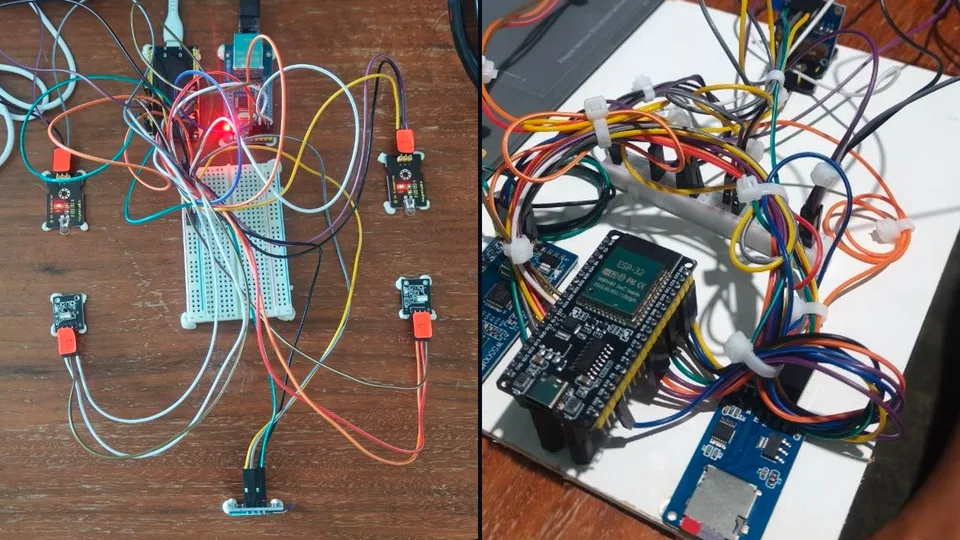
Two photos of the station electronics: a bench prototype with an ESP32, wired Ethernet and four infrared sensor modules, and one assembled station board with its wiring tied down

Live event hardware · public repo

Eight counting stations, four days, nobody on site

A live event needed eight stations that count the tokens visitors drop in and show every total on a TV as it happens. It had to run for four days with no one there to fix it. It did.

Technical details

The hard part

I could not step in during the event. Every failure had to recover without me.

Decisions

  • Wired Ethernet, not WiFi. Each station already needed a power cable, and the venue's airwaves were crowded.
  • Every token is saved to the SD card at once. On restart a station restores its count from the hub, then the card.
  • Stations send the running total, not the change. A lost message is fixed by the next one.

What went wrong

A cheap SD card adapter jammed the shared bus and made the network chip vanish, so each device got its own bus. The SD cards also arrived as 64GB, which the firmware library cannot read.

ESP32 · C++ · FastAPI · WebSockets · Raspberry Pi

Security · personal project

Will: a vault that opens only after you are gone

When someone dies, the family has to hunt for accounts, policies and wishes. Will keeps all of it encrypted. It opens to the executors only after enough of them confirm the death and a waiting period has passed.

Technical details

The hard part

No single executor should be able to open the vault, and a stolen copy of the database should be useless.

Decisions

  • The vault key is split with Shamir's secret sharing. Fewer than the required number of executors cannot rebuild it.
  • Each share is sealed to that executor's own key, which only their passphrase unlocks.
  • Any login by the owner cancels the countdown and clears every declaration.

What I would flag

The waiting period is enforced by the app's clock, not by cryptography. Once enough executors have declared, someone holding the database file could open it early.

Node.js · AES-256-GCM · scrypt · Shamir k-of-n · X25519

Mobile app · closed beta on Google Play

sanctuary: a private journal on your phone

A journaling app built to keep your writing private. I built it alone, from the first screen to the Play Store. It is at version 2.8 with 17 people in the closed beta.

Technical details

The hard part

A journal holds the most private writing a person has. It has to work offline and stay safe when someone else picks up the phone.

Decisions

  • Local first. Entries live in a database on the phone, and cloud sync is optional with a preview before anything uploads.
  • A PIN or biometric lock, plus a duress PIN that opens a fake empty journal.
  • AI requests go through a server function, so no API key ships inside the app.

What I would flag

Billing is not switched on yet, and there is no iOS release.

Flutter · Dart · SQLite · Supabase · Claude API · GitHub Actions

AI project · live demo

Primer: learn any topic in one sitting

Type a topic and Primer researches it on the web. Then it gives you four ways in: a paper with sources, a slide deck, a narrated video and an animated explainer.

Technical details

The hard part

AI output is slow and costs money on every run, and generated audio costs more on top.

Decisions

  • One research call with web search. Every view is then written from that one set of sources.
  • The model writes into fixed JSON shapes, so every view renders the same way each time.
  • All narration uses the voices built into the browser. There are no audio files and no voice costs.

What I would flag

A new topic costs roughly US$1-2, which is an estimate and not yet measured. Studies quote web sources, so the public demo shows saved samples only.

Node.js · Claude API · web search · browser speech

Smaller things

Made for fun. Each one runs in your browser.

Stack

AI
Claude API and OpenAI API in production, RAG, structured output, deterministic fallbacks, agent guardrails, cost controls
Daily
PHP (Laravel), JavaScript, TypeScript, React, Next.js, Python (FastAPI), PostgreSQL, MySQL, AWS, Linux, CI/CD
Also shipped in
Rust (Tauri), Dart (Flutter), C++ (ESP32), Java (Joget)

Got something to build?

Tell me the problem. I will tell you honestly if I can solve it, and how long it will take.